
A customer signing in to a portal may send a session cookie through NGINX with every request. On a server that handles HTTPS for that portal, an NGINX worker can see the cookie after decryption. That helps explain why two vulnerabilities disclosed on November 18 deserve attention from anyone responsible for a public website or API. Researchers demonstrated that, under certain conditions, someone with no account on the site could run code inside the process handling its traffic. Read the Wiz findings and Rapid7’s technical analysis.
November 19 update on active exploitation. Western Australia’s Cyber Security Unit reported that it had been alerted to exploitation in the wild involving at least one of the two NGINX HTTP/2 flaws listed in its advisory, CVE-2026-123007 and CVE-2026-123633. Which flaw was exploited remains unspecified. At publication, the centre had received no reports of exploitation on Western Australian Government networks. A day earlier, CERT-EU had reported no known exploitation in the wild. Western Australian advisory, November 19 · CERT-EU advisory, November 18.
On this page
Which NGINX versions fix CVE-2026-123007 and CVE-2026-123633?
| Release branch | Fixed version |
|---|---|
NGINX Open Source stable | 1.30.7 |
NGINX Open Source mainline | 1.31.9 |
NGINX Plus long-term support (LTS) | 37.0.8.1 |
NGINX Plus continuous release (CR) | 37.3.0.1 |
Use the fixed release for your branch or a later supported build. If a distribution supplies NGINX, check its package revision for both CVEs. NGINX Open Source advisories · NGINX Plus release notes · Ubuntu package status for CVE-2026-123007 and CVE-2026-123633.
What went wrong in NGINX?
HTTP/2 lets a browser request several things over a single connection. To keep a fast sender from overwhelming a slow receiver, the two sides track how much data can be sent. CVE-2026-123007 is a flaw in that accounting. NGINX can arrive at an invalid length when copying response data and write outside the memory set aside for it. The worker can crash. Rapid7 also demonstrated remote code execution with the worker’s permissions. Wiz reproduced code execution on a server delivering ordinary static files, so a server hosting only images or downloads belongs in the review. The affected code dates back to NGINX 1.9.5. F5 advisory · Rapid7 findings · Wiz findings.
CVE-2026-123633 matters especially to reverse-proxy operators. A reverse proxy accepts a client request and forwards it to an application server. Under connection pressure, affected versions of NGINX can free memory for an HTTP/2 connection while a request still depends on it. Engineers call this a use-after-free. Wiz demonstrated code execution for this flaw as well. It affects upstream versions dating back to 1.19.7. F5 advisory for CVE-2026-123633 · Affected upstream versions.
How to check whether your NGINX server is exposed
Trace where HTTP/2 actually ends
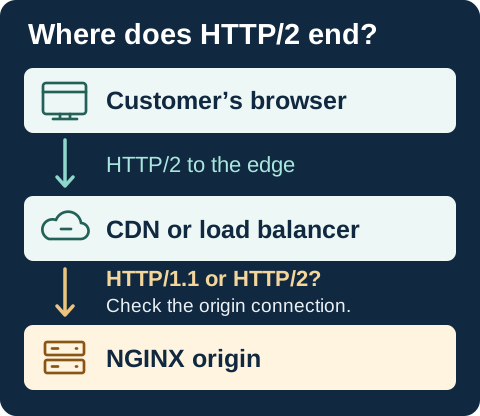
Your browser may show HTTP/2 because it negotiated that protocol with a content delivery network (CDN). The CDN might use HTTP/1.1 for its connection to your NGINX origin. Check both connections, then check whether anyone can reach the origin directly or through another hostname. Prioritize exposed listeners serving sign-ins, customer portals and APIs. Both flaws require HTTP/2 on the affected NGINX listener. Wiz exposure analysis.
Inspect each instance
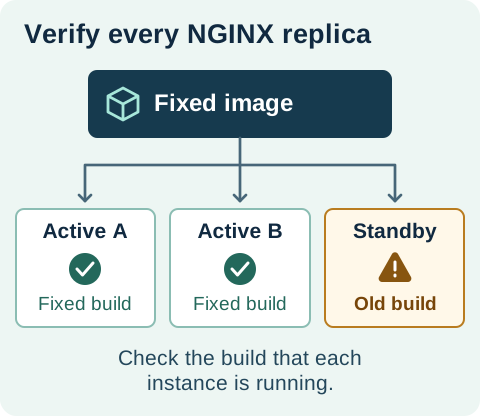
nginx -T displays the configuration on disk, including imported files. Look for http2 on and the older http2 parameter on a listen directive. Keep the output private because configuration files can contain credentials. Record the installed package revision or deployed container image for each affected instance, including standby nodes. NGINX command reference · HTTP/2 module documentation.
How to verify the NGINX patch
Follow your vendor’s restart or rolling replacement procedure. A configuration reload alone leaves the existing executable in service. Verify the running build on every replica, update the image used to launch replacements, and test a normal login and API request through the production traffic path. NGINX process control.
If a patch must wait
CERT-EU recommends temporarily disabling HTTP/2 on exposed listeners. Keep HTTPS enabled, validate the change and confirm that affected sites work over HTTP/1.1. Identify services that require HTTP/2, particularly native gRPC, and move them to a patched endpoint before changing the listener. CERT-EU advisory · NGINX gRPC documentation.
Could someone have stolen customer data?
The answer depends on what the worker handled and what its account could access. A proxy in front of a customer portal may process session cookies, API tokens and private responses. If one NGINX instance serves several businesses or applications, each deserves a place in the investigation. Wiz impact analysis.
If you find unexplained worker crashes, preserve the error logs and note the times before replacing the instance. Compare those times with host process records, outbound network connections and identity-provider activity. A crash gives an investigator a starting point. An unexpected process launched by the worker, followed by an outbound transfer or unusual use of a customer session, warrants incident response. Isolate the suspect instance, preserve the evidence and assess which credentials or sessions need revocation. CERT-EU compromise assessment.
NGINX HTTP/2 patching FAQ
Does a CDN protect my NGINX origin from these HTTP/2 flaws?
A CDN that connects to your origin over HTTP/1.1 keeps those requests out of the affected HTTP/2 code. Check whether clients can also reach NGINX directly or through another hostname. Each reachable HTTP/2 listener on an affected build still needs attention.
How can I tell whether my Linux distribution backported the NGINX fix?
Look up both CVEs in the distribution’s security tracker for your operating system release. Compare the full package revision with the fixed revision the vendor lists, then verify that the running service uses that package. A version printed in an HTTP response header cannot establish patch status.
Can I turn off HTTP/2 temporarily and keep HTTPS?
Yes. An HTTPS listener can use TLS with HTTP/1.1. Before changing protocols, test the applications that use the listener. Native gRPC depends on HTTP/2, so it may need a patched endpoint of its own.
What should I ask my hosting provider after an NGINX worker crash?
Ask which sites shared the worker, which build was running at the time, and what process, network and sign-in records the provider preserved. Those records can help establish whether the incident affected availability alone or whether someone accessed customer sessions or data.
How Root Managed Services can help
If you run a business on an older web server, you may know exactly which portal your customers use and have little visibility into the servers behind it. Our server administration team can trace that path with your administrator or hosting provider, identify the systems handling private data and verify the fix on the machines serving customers. Our cybersecurity team can review what the NGINX account can read and reach, so a compromise of one site has fewer opportunities to expose another.
Start with the portal’s domain and your hosting provider. We can help you establish where customer traffic is decrypted, which running servers have the fix, and what evidence is available for the period before patching.